
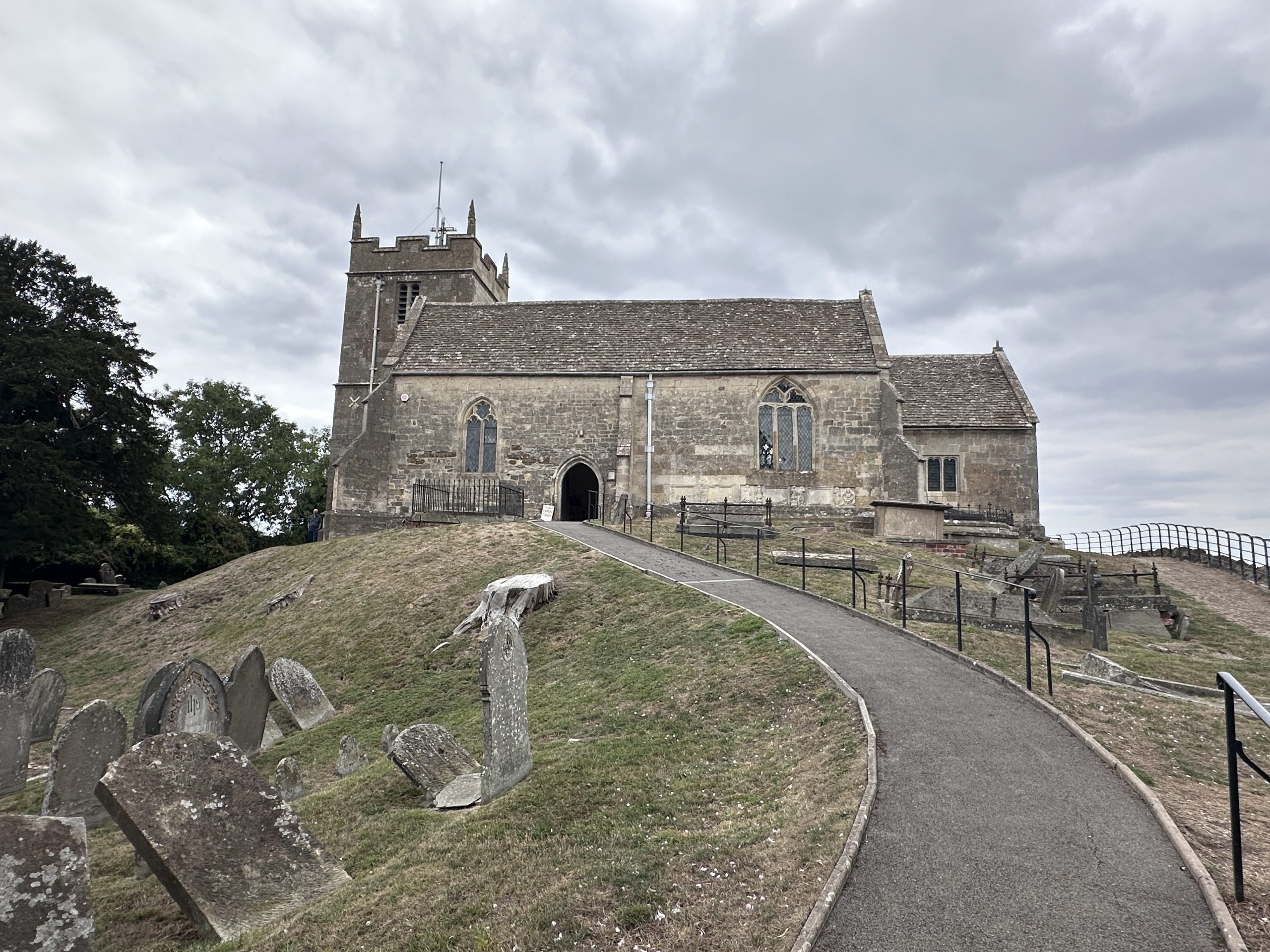
The building (or rebuilding) of the Church dedicated to St Bartholomew at Churchdown is beleived to have been constructed in 1175 to commemorate a miracle connected to Thomas a Becket. How do we know about the miracle?
- Thomas a Becket was Archbishop of Canterbury when he was murdered in his cathedral
- Some people thought that he should be declared a ‘saint’ but for a pope to agree he needed to be convinced that Thomas was responsible for miracles after he died (not a view shared by most churches today)
- So, some of the brightest scholars of the time investigated reports of possible miracles and recorded their findings (see abridged extracts)
- The Churchdown Miracle was recorded in detail in the 2 books written in 1173 which helped persuade the pope to agree to declare Thomas a saint and became widely circulated throughout Europe
- The story of William’s rescue was also recorded in 8 stained-glass window panels in Canterbury Cathedral (see photos)
Why was William in a deep trench?
- The Archbishop of York controlled the area and was paying for a lead pipe to be laid to bring clean water from a spring near this church probably to a large house in the village below in which he frequently stayed
- It is thought that the best route for the pipe needed to go a short distance through a small hillock
- For centuries Churchdown was the important centre of the Archbishop of York’s properties in Gloucestershire which were linked to St Oswald’s Priory in Gloucester
- Various Archbishops of York stayed in Churchdown many times
- Churchdown and St Oswald’s were significant enough that on the 16th May 1177 Pope Alexander Ill issued a judgement stating that they should continue to be administered from York not Canterbury
- Churchdown was also a major wine supplier to the King at this time!
What William of Canterbury recorded
‘Roger, the bishop of York, was bringing water into his village of Churchdown from the top of a mountain (!) about five hundred paces away. In the middle bulged a hill about 24 feet high, its steep top looking down on the surrounding plains and fields. The hill was dug through, such that it might take the course of the water in a straight direction. A certain William, who hired out his labours from the neighbouring city of Gloucester, was hard at work. When he was laying the lead pipe in the depths of the opened hill, a heap of earth that had been dug out fell on top of him. His companions were flying here and there and wanted to dig him out, when behold, again from a steep cliff, an unstable, overhanging mound of earth suddenly rolled down and trapped the youth. They estimated what fell on him to be about a hundred cartloads!
When he saw that a means of escape was denied to him, he sighed for the Lord, the first and last refuge for anyone in any need. He also invoked the blessed Virgin Mary, and when he was tormented to the point of death, the name of the martyr Thomas. From this point he regained the ability to breathe. A local woman had a vision, and in the morning said to her son, “I think, son, that the one who was buried lives.” And he, contrary to his usual custom, immediately got up from bed and went into the fields, putting his ear to the earth, he heard something like a groan. And he called to the man in charge of the fields, who had gone out early to care for the draught horse that he had turned out at night, saying, “See here! He still lives, for I hear something like a man’s crying groan.” He answered,
“It is nothing, and if all of Gloucester said it was true, I would not believe it.”
“Come and listen” he replied, and when they had heard it there came many – the old man, the young boy, the woman – and they applied themselves to remove the earth with scoops, platters, basins, and other homely utensils. The buried man, hearing the noisy activity and everyone working to find him first, called out to those above him, because he was worried either that they would hurt him with their iron tools or that they would fail to get to him. Then at last the buried man appeared, with battered cheeks and arms crushed. And so, he was brought back to the surface so that sinners might be brought out of the depths?
What Benedict of Peterborough recorded
A fall of earth surrounded a man, and though he was compressed on all sides, he was not destroyed. This happened in the village in the vicinity of Gloucester that the English call Churchdown, and the man’s name was William. That man was constructing an aqueduct and was in a pit extending lead pipe. It was late afternoon, and it is said that the pit was 24 feet deep.
The overhanging earth fell on the worker and filled up the pit such that it was level with the surrounding ground. Everyone there shared the opinion that he must be dead. And so, the priest of the village conducted the funeral rites for him, though they would not be the last ones, as he thought, but the first!
In the morning, a young man of the same village, led by divine inspiration, came that way and heard a sound under the earth. He said to the herald of the village, “The man buried yesterday is still alive. He replied, “What you say is impossible: he died instantly.” In response, the young man said, “If you doubt it, come and hear.” He agreed and put his ears upon the earth, and the hesitating doubt was removed. The rumour sounded throughout the village. The people came with spades and mattocks and other digging tools.
The earth was lifted, the man disinterred. He was brought out alive and uninjured!’
How do we know about the miracle?
- Thomas a Becket was Archbishop of Canterbury when he was murdered in his cathedral
- Some people thought that he should be declared a ‘saint’ but for a pope to agree he needed to be convinced that Thomas was responsible for miracles after he died (not a view shared by most churches today)
- So, some of the brightest scholars of the time investigated reports of possible miracles and recorded their findings (see abridged extracts)
- The Churchdown Miracle was recorded in detail in the 2 books written in 1173 which helped persuade the pope to agree to declare Thomas a saint and became widely circulated throughout Europe
- The story of William’s rescue was also recorded in 8 stained-glass window panels in Canterbury Cathedral.
What William of Canterbury recorded
‘Roger, the bishop of York, was bringing water into his village of Churchdown from the top of a mountain (!) about five hundred paces away. In the middle bulged a hill about 24 feet high, its steep top looking down on the surrounding plains and fields. The hill was dug through, such that it might take the course of the water in a straight direction. A certain William, who hired out his labours from the neighbouring city of Gloucester, was hard at work. When he was laying the lead pipe in the depths of the opened hill, a heap of earth that had been dug out fell on top of him. His companions were flying here and there and wanted to dig him out, when behold, again from a steep cliff, an unstable, overhanging mound of earth suddenly rolled down and trapped the youth. They estimated what fell on him to be about a hundred cartloads!
When he saw that a means of escape was denied to him, he sighed for the Lord, the first and last refuge for anyone in any need. He also invoked the blessed Virgin Mary, and when he was tormented to the point of death, the name of the martyr Thomas. From this point he regained the ability to breathe. A local woman had a vision, and in the morning said to her son, “I think, son, that the one who was buried lives.” And he, contrary to his usual custom, immediately got up from bed and went into the fields, putting his ear to the earth, he heard something like a groan. And he called to the man in charge of the fields, who had gone out early to care for the draught horse that he had turned out at night, saying, “See here! He still lives, for I hear something like a man’s crying groan.” He answered,
“It is nothing, and if all of Gloucester said it was true, I would not believe it.”
“Come and listen” he replied, and when they had heard it there came many – the old man, the young boy, the woman – and they applied themselves to remove the earth with scoops, platters, basins, and other homely utensils. The buried man, hearing the noisy activity and everyone working to find him first, called out to those above him, because he was worried either that they would hurt him with their iron tools or that they would fail to get to him. Then at last the buried man appeared, with battered cheeks and arms crushed. And so, he was brought back to the surface so that sinners might be brought out of the depths?
This information is from an information display at the 850th anniversary weekend of Churchdown Hill church dedicated to St Bartholomew and their working in collating this information is acknowledged Their stated sources with relevant links added are:-
Gwen Waters, 1999, The history of Churchdown’