In July 2025 I undertook a survey of available public data on Parish and Town Council vacancies across Gloucestershire and this is a publication of the data from from this research. There are no current plans to update it. Although it might be useful for others to do similar surveys in other counties to evidence the extent to which parish and town council vacancies occur.
In the context of Local Government Reorganisation it is vital that re-invigorating parish and town council democracy needs to be a key vision of the ambitions for any new unitary councils within Gloucestershire.
An article about the research was written by BBC funded Local Democracy Reporter Carmelo Garcia and can be found on the Gloucestershire Live website and also on the Gloucester News Centre and other local media including
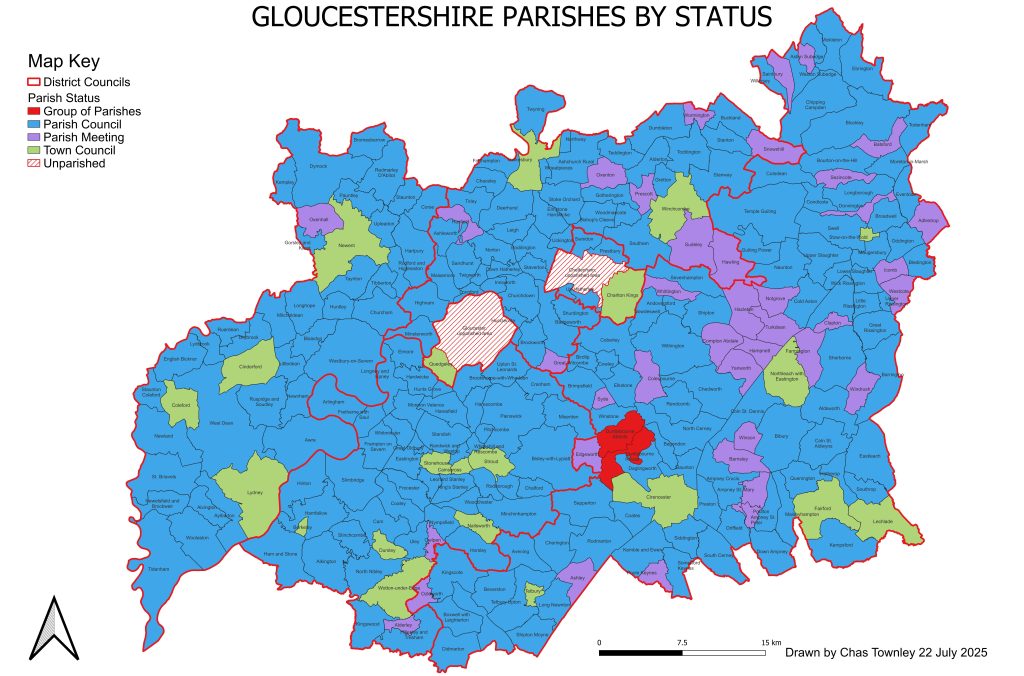
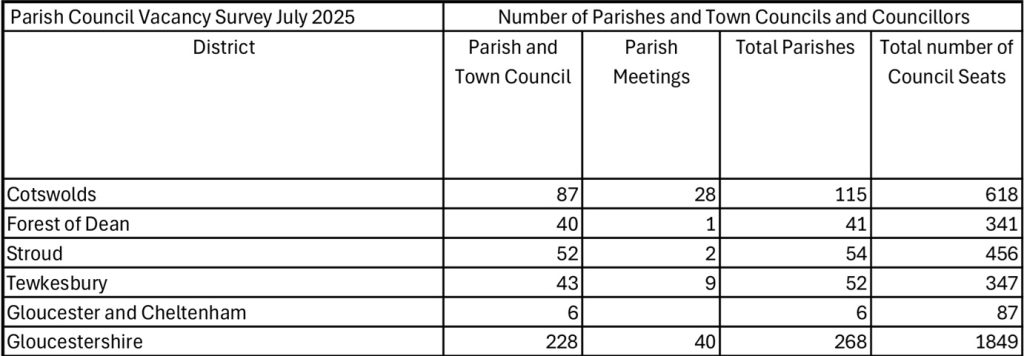
There are in total 268 parishes across Gloucestershire, these include 40 parish meetings, these are small communities and do not have an elected parish council and the parish meeting, which can be attended by all electors make decisions, electing a Parish Meeting Chair on an annual basis.
228 local councils mostly known as a parish council but 21 are styled as town councils. Parish councils can also opt for a number of different styles including village council, community council, neighbourhood council, but none in Gloucestershire has chosen to do so. The different styles are included in Section 14 of the Local Government Act 1972 and were introduced in 2008.
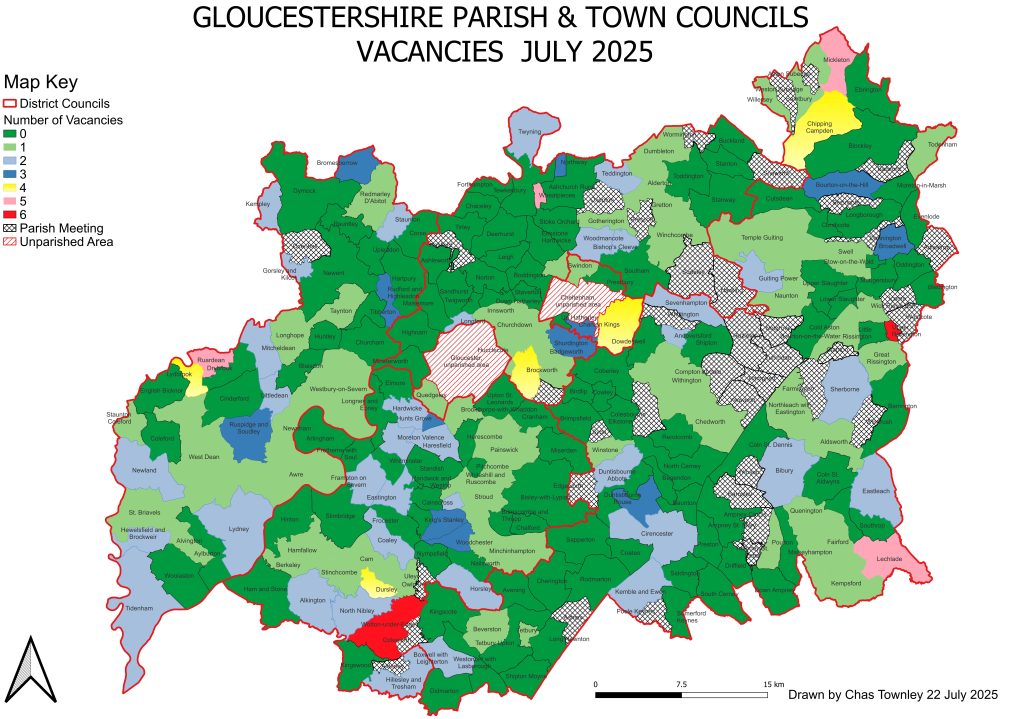
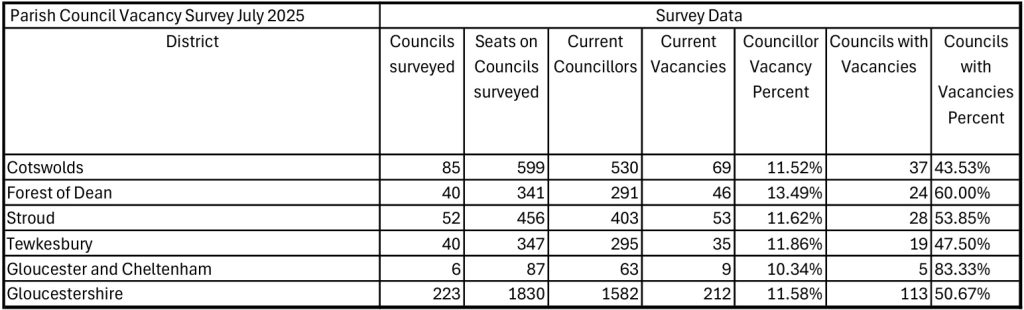
The table below shows the number of vacancies for each parish or town council by district council area and at the time of the survey found 212 vacancies across 113 councils which represents just over 50% of parish and town councils with vacancies and overall vacancies of just over 1 in 9 council seats.
A spreadsheet with data tables is also attached
The spreadsheets include:-
Vacancies by Council Type – this shows the vacancies broken down by type of council – Parish and Town Councils and also the 1 Group of Councils (this is a type of organisation that groups parishes together to act as a joint council for their parishes).
Vacancies by Size of Council – the minimum size of council is 5 seats and the largest has 21 seats. Normally there is some formula which Districts use to allocate the number of seats.
Vacancies Number Descending – shows the councils ordered by largest number of vacancies – 6 down to zero
Vacancy percentage descending – shows the councils ordered by percentage number of vacancies – 54% down to zero
Individual District Data tables – these are data worksheets and aren’t very pretty
Note on methodology: Two primary sources for data was used individual parish and town council websites and also information on District Council websites. In case of two Districts this was supplemented by data from election teams on total number of council seats. The data provided is the most up to date based on the sources but its also possible that there is errors and omissions in the published data. Evidence for this is that alongside parish councillor data councils also often publish county councillors and occasionally this shows councillors who stood down or weren’t re-elected in May. There were 5 councils were not included in the survey as data was not available or the website was otherwise unavailable.